

Micro Volume Spectrophotometer
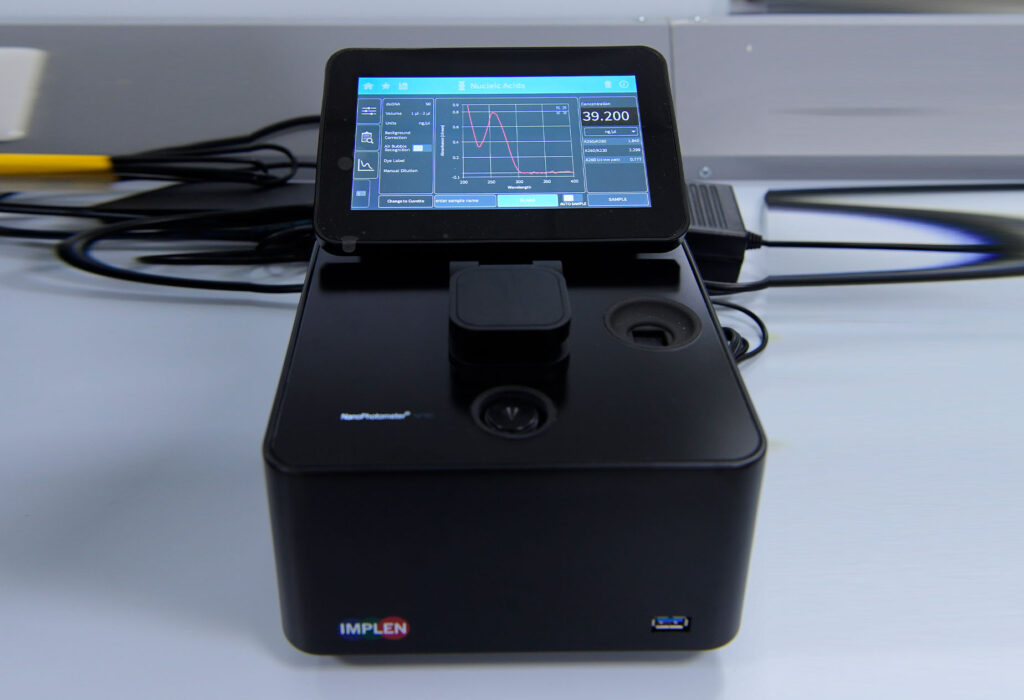
Make
IMPLEN
Model
Nanophotometer Np80 Touch
Nano Photometer is a type of spectrophotometer used for measuring the absorbance of light by a sample. It is called “nano” because it can measure very small volumes of samples, typically in the range of 0.5 µL to 2 µL. This makes it useful for applications such as DNA, RNA, and protein quantification, as well as for measuring the concentration and purity of other biological and chemical samples.
Nano photometers use a combination of light sources, filters, and detectors to measure the absorbance of light at specific wavelengths. They typically use a tungsten halogen lamp as the light source, and have filters that allow the user to select specific wavelengths for measurement.
The detectors used in nano photometers are typically photodiodes or CCD arrays, which convert the light signal into an electrical signal that can be measured and analyzed. Nano photometers can be either single-beam or double-beam instruments.
Single-beam instruments measure the absorbance of the sample relative to a blank, while double-beam instruments measure the absorbance of the sample and a reference simultaneously. Double-beam instruments are generally considered more accurate, since they correct for any variations in the light source or detector over time.
Overall, nano photometers are useful tools for a wide range of biological and chemical applications, providing rapid and accurate measurements of sample concentration and purity in very small volumes.