

High Pressure Homoginiser
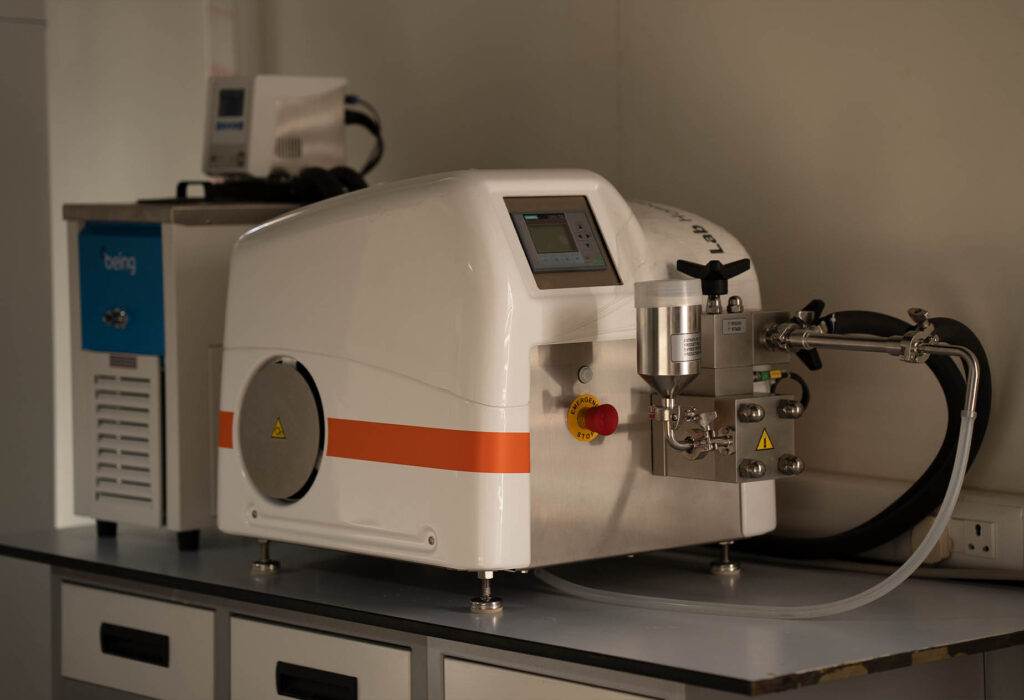
Make
Gea Niro Sovai
Model
Panda Plus 2000
High-pressure homogenizer is a laboratory instrument used to disrupt cells, tissues, or particles in a liquid suspension, and to create stable, homogeneous emulsions or suspensions. The instrument works by applying high pressure to a sample as it is forced through a small orifice or valve, causing shear forces and turbulence that break up the particles and create a more uniform distribution.
High pressure homogenizers are commonly used in biotechnology, food processing, and pharmaceutical industries for a variety of applications, such as cell disruption, emulsification, nanoparticle synthesis, and drug delivery.
They can process a wide range of sample volumes and types, from small laboratory-scale samples to large-scale industrial batches. High pressure homogenizers offer several advantages over other methods used for particle disruption and emulsification, such as sonication, bead milling, or rotor-stator homogenization.
Overall, high pressure homogenizers are versatile laboratory instruments that can be used for a wide range of applications in biotechnology, food processing, and pharmaceutical industries. They provide a reliable and efficient way to create stable, homogeneous suspensions or emulsions, and are an essential tool in many scientific and industrial processes.