


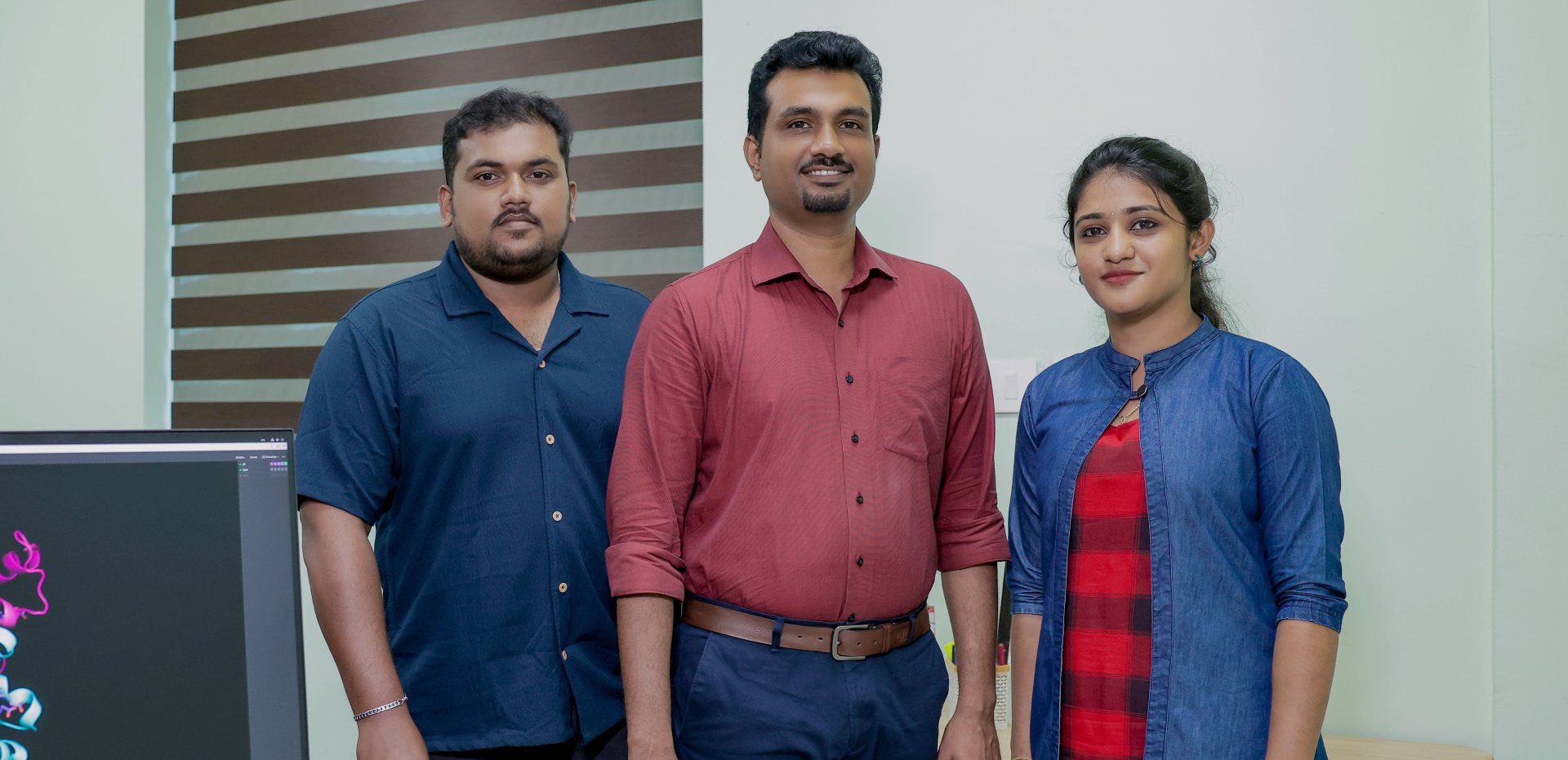
Dr. Abhinand CS earned his PhD in Computational Biology and Bioinformatics from the University of Kerala, India. He gained postdoctoral experience in mass spectrometry-based proteomics at the Institute for Advanced Biosciences (IAB), Keio University, Japan. Subsequently, he served as a scientist in the Department of Computational Biology and Bioinformatics at the University of Kerala, where he focused on viral informatics studies related to emerging viruses. In 2022, he joined the Center for Systems Biology and Molecular Medicine at Yenepoya University as an Assistant Professor, where he investigated host-pathogen interactions associated with EBV, NiV, and SARS-CoV-2. At present, he is working as a Scientist C at the Institute of Advanced Virology, focusing on elucidating viral entry mechanisms of emerging viruses using machine learning-based approaches and developing new druggable candidates through AI-based drug discovery.
Institute of Advanced Virology, Trivandrum
CSBMM, Yenepoya (Deemed to be University), Mangalore
Department of Computational Biology & Bioinformatics, University of Kerala, Trivandrum
Department of Computational Biology & Bioinformatics, University of Kerala, Trivandrum
Keio Institute for Advanced Biosciences, Japan
Multi-omics, Bioinformatics, Artificial Intelligence and Machine Learning, Data Science
2024
Teachers Associateship for Research Excellence (TARE) award, SERB, Govt. of India
2017
Kuraray/Leave a Nest Grant Runner-up award
2015
Travel Grant award, SIUCEB, Govt. of Kerala
2014
International Travel Grant, VirginiaTech, USA
2013
Best poster award, International Conference on “Tropical Roots and Tubers for Sustainable Livelihood under Changing Agro-climate”
2012
Research fellowship award, KSCSTE, Govt. of Kerala
Understanding the receptors and molecular pathways that facilitate viral entry into human cells is crucial for developing novel therapeutic approaches. Computational methods offer a powerful platform for identifying host-pathogen interactions by using sequence- and structure-based data. The major focus of the lab is to develop machine-learning models for predicting viral entry receptors and other human interactomes. Through this, the lab aims to uncover both common and virus-specific receptors, as well as the molecular pathways viruses use to invade host cells. We also interest in capturing virus-induced host responses using the data generated from advanced techniques such as high-throughput sequencing and mass spectrometry, and converting it into a public repository. Besides, the lab has a strong interest in identifying antiviral compounds through drug repurposing and AI-driven drug design, with the goal of contributing to the discovery of effective therapeutic solutions for combating viral infections
2025-2028
Decoding interactions of dengue virus proteins with human ion channels for alternative therapeutic strategies and drug repurposing using machine learning based approach. ANRF—Prime Minister’s Early Career Research Grant Scheme
2023-2026
Osteogenesis Imperfecta: Quest for molecular curative strategies for detection and informed therapy. (Co-PI). Indian Council of Medical Research (ICMR)
Mahin, A., Soman, S. P., Modi, P. K., Raju, R., Keshava Prasad, T. S., & Abhinand, C. S. (2024). Meta-analysis of the serum/plasma proteome identifies significant associations between COVID-19 with Alzheimer’s/Parkinson’s diseases. Journal of neurovirology, 30(1), 57–70. https://doi.org/10.1007/s13365-023-01191-7
Krishnan, D., Babu, S., Raju, R., Veettil, M. V., Prasad, T. S. K., & Abhinand, C. S. (2024). Epstein-Barr Virus: Human Interactome Reveals New Molecular Insights into Viral Pathogenesis for Potential Therapeutics and Antiviral Drug Discovery. Omics : a journal of integrative biology, 28(1), 32–44. https://doi.org/10.1089/omi.2023.0241
Hemavathi, K. N., Middha, S. K., Raju, R., Pilankatta, R., Keshava Prasad, T. S., & Abhinand, C. S. (2024). Computational screening of phytocompounds from C.amboinicus identifies potential inhibitors of influenza A (H3N2) virus by targeting hemagglutinin. Journal of biomolecular structure & dynamics, 1–13. Advance online publication. https://doi.org/10.1080/07391102.2024.2424940
Mahin, A., Chikmagalur Ravindra, S., Ramesh, P., Naik, P., Raju, R., Keshava Prasad, T. S., & Abhinand, C. S. (2024). Unveiling Actin Cytoskeleton Role in Mediating Chikungunya-Associated Arthritis: An Integrative Proteome-Metabolome Study. Vector borne and zoonotic diseases (Larchmont, N.Y.), 24(11), 753–762. https://doi.org/10.1089/vbz.2024.0018
Hemavathi, K. N., Skariyachan, S., Raju, R., Keshava Prasad, T. S., & Abhinand, C. S. (2024). Computational screening of potential anti-inflammatory leads from Jeevaneeya Rasayana plants targeting COX-2 and 5- LOX by molecular docking and dynamic simulation approaches. Computers in biology and medicine, 171, 108164. https://doi.org/10.1016/j.compbiomed.2024.108164
Kumari, P., Abhinand, C. S., Kumari, R., Upadhyay, A., & Satheeshkumar, P. K. (2024). Design, development and characterization of a chimeric protein with disulfide reductase and protease domain showing keratinase activity. International journal of biological macromolecules, 278(Pt 4), 135025. https://doi.org/10.1016/j.ijbiomac.2024.135025
Banjan, B., Vishwakarma, R., Ramakrishnan, K., Dev, R. R., Kalath, H., Kumar, P., Soman, S., Raju, R., Revikumar, A., Rehman, N., & Abhinand, C. S. (2024). Targeting AFP-RARβ complex formation: a potential strategy for treating AFP-positive hepatocellular carcinoma. Molecular diversity, 10.1007/s11030-024-10915-8. Advance online publication. https://doi.org/10.1007/s11030-024-10915-8
Banjan, B., Raju, R., Keshava Prasad, T. S., & Abhinand, C. S. (2024). Computational identification of potential bioactive compounds from Triphala against alcoholic liver injury by targeting alcohol dehydrogenase. Molecular diversity, 10.1007/s11030-024-10879-9. Advance online publication. https://doi.org/10.1007/s11030-024-10879-9
Abhinand, C. S., Prabhakaran, A. A., Krishnamurthy, A., Raju, R., Keshava Prasad, T. S., Nair, A. S., Rajasekharan, K. N., Oommen, O. V., & Sudhakaran, P. R. (2023). SARS-CoV-2 variants infectivity prediction and therapeutic peptide design using computational approaches. Journal of biomolecular structure & dynamics, 41(20), 11166–11177. https://doi.org/10.1080/07391102.2022.2160819
Abhinand, C. S., Prabhakaran, A. A., Krishnamurthy, A., Raju, R., Keshava Prasad, T. S., Nair, A. S., Rajasekharan, K. N., Oommen, O. V., & Sudhakaran, P. R. (2023). SARS-CoV-2 variants infectivity prediction and therapeutic peptide design using computational approaches. Journal of biomolecular structure & dynamics, 41(20), 11166–11177. https://doi.org/10.1080/07391102.2022.2160819
Abhinand, C. S., Ibrahim, J., Keshava Prasad, T. S., Raju, R., Oommen, O. V., & Nair, A. S. (2023). Molecular docking and dynamics studies for the identification of Nipah virus glycoprotein inhibitors from Indian medicinal plants. Journal of biomolecular structure & dynamics, 41(19), 9211–9218. https://doi.org/10.1080/07391102.2022.2153169
Abhinand, C. S., Nair, A. S., Krishnamurthy, A., Oommen, O. V., & Sudhakaran, P. R. (2022). Potential protease inhibitors and their combinations to block SARS-CoV-2. Journal of biomolecular structure & dynamics, 40(2), 903–917. https://doi.org/10.1080/07391102.2020.1819881
Abhinand, C. S., Galipon, J., Mori, M., Ramesh, P., Prasad, T. S. K., Raju, R., Sudhakaran, P. R., & Tomita, M. (2023). Temporal phosphoproteomic analysis of VEGF-A signaling in HUVECs: an insight into early signaling events associated with angiogenesis. Journal of cell communication and signaling, 17(3), 1067–1079. https://doi.org/10.1007/s12079-023-00736-z
Abhinand, C. S., Athira, P. A., Soumya, S. J., & Sudhakaran, P. R. (2020). Multiple Targets Directed Multiple Ligands: An In Silico and In Vitro Approach to Evaluating the Effect of Triphala on Angiogenesis. Biomolecules, 10(2), 177. https://doi.org/10.3390/biom10020177
Abhinand, C. S., Raju, R., Soumya, S. J., Arya, P. S., & Sudhakaran, P. R. (2016). VEGF-A/VEGFR2 signaling network in endothelial cells relevant to angiogenesis. Journal of cell communication and signaling, 10(4), 347–354. https://doi.org/10.1007/s12079-016-0352-8
Project Associate
devikaraj2506@gmail.com

Ph.D. Scholar
jj.jagannathrs@d1.iav.res.in
JRF
parusureshpkd@gmail.com

Project Scientist
aaryakr@d1.iav.res.in