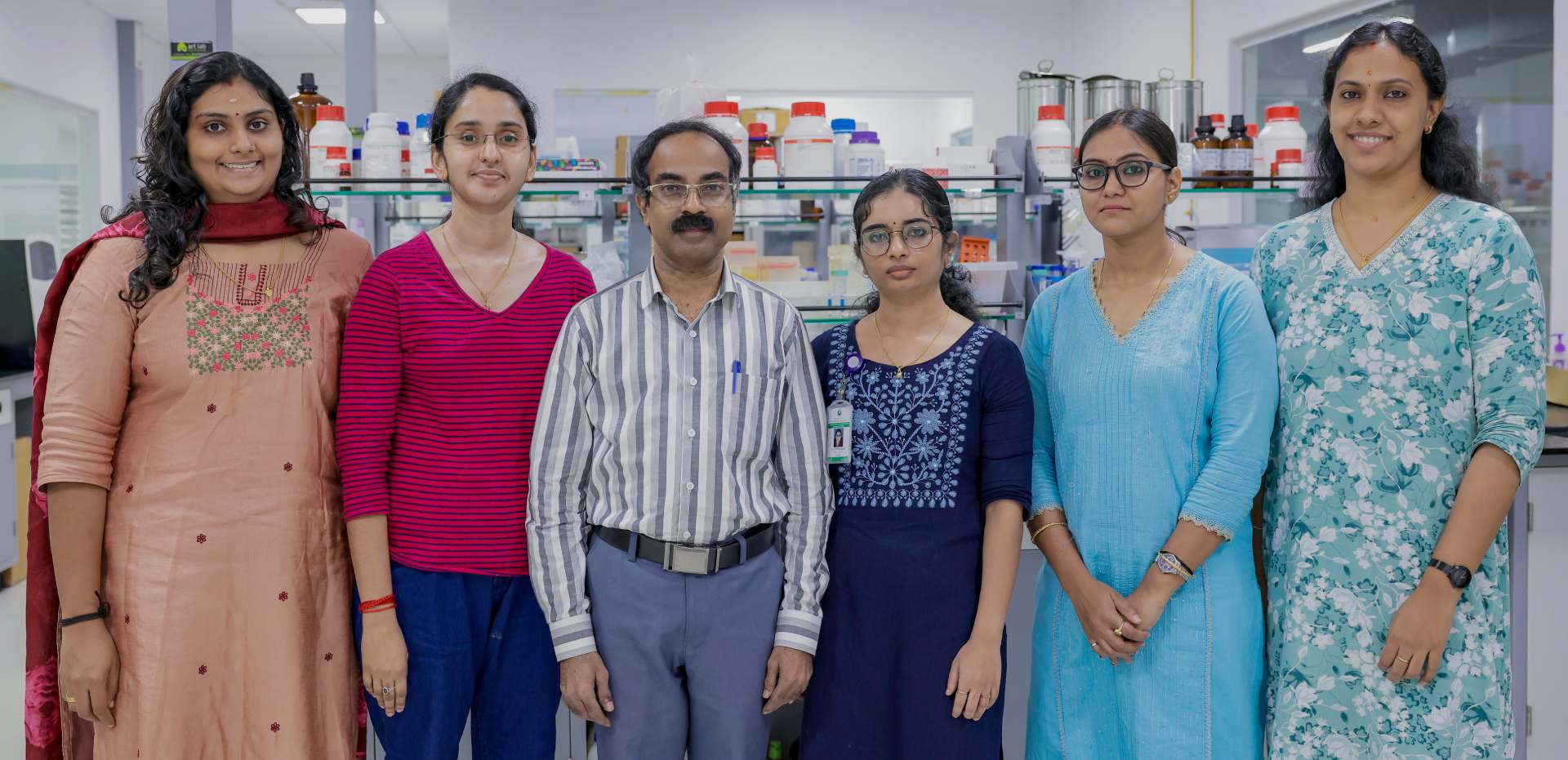
Dr.Mohanan Valiya Veettil earned his Ph.D. in Biotechnology from Cochin University of Science and Technology, Kerala, in 2005. He completed his Post-Doctoral studies in virology at University of Kansas Medical Centre and at Chicago Medical School, Rosalind Franklin University of Medicine and Science, USA. Following his post-doctoral studies, he served as an Assistant Professor of Research and Associate Member of the School of Graduate and Postdoctoral studies in the Department of Microbiology and Immunology at Chicago Medical School, USA. He returned to India in 2016 and joined Cochin University of Science and Technology, Department of Biotechnology as DBT-Re-Entry Faculty. He joined the Institute of Advanced Virology as Senior Principal Scientist in 2020. He has published more than 50 research articles in top-peer reviewed journals in the field of virology, and two of his research articles have been placed in the best papers published in biology and medicine.
Institute of Advanced Virology (IAV), Thonnakkal, Bio 360 Life Sciences Park, Thiruvananthapuram 695317
Department of Biotechnology, Cochin University of Science and Technology, Cochin 682022, Kerala.
Department of Microbiology and Immunology, Chicago Medical School, Rosalind Franklin University of Medicine and Science North Chicago, Illinois, USA.
Dept. of Microbiology and Immunology, Chicago Medical School, Rosalind Franklin University of Medicine and Science North Chicago, Illinois, USA.
Molecular Virology, Biology of viruses, Monoclonal antibodies and antivirals, Virus-host cell interaction
Cochin University of Science and Technology, Cochin, India
Dept. of Biotechnology, Cochin University of Science and Technology, Cochin, India.
University of Kansas Medical Center, Kansas, USA. Dept. of Microbiology and Immunology, Chicago Medical School, North Chicago, Illinois, USA.
2015
Awarded Ramalingaswami Re-entry Fellowship, DBT, Govt. of India
2015
Research paper placed in top 2% of papers published in biology and medicine
2010
Research article ranked in top 2% of papers published in biology and medicine
2000
Awarded Junior Research Fellowship in Life Sciences, CSIR-JRF
1997
Awarded Agricultural Scientist Recruitment Board National Eligibility Test for Lectureship, India.
My research group focuses on the interaction of viral proteins with host cellular molecules and the development of monoclonal antibodies and antivirals that functionally block the interaction during virus infection. Specifically, we focus on Virus-like particle production and identifying which proteins in Nipah virus and Kyasanur forest disease virus are essential to gain access to cells for a successful infection. Apart from this, we also investigate the cellular and molecular mechanisms of Epstein-Barr virus induced signal transduction pathways, which are critical for oncogenic transformation.
2026-2029
Developing a novel c-Myc targeting anti-cancer peptide from a viral protein for the treatment of lung cancer-ICMR
2024 – 2029
Identification and characterization of a functional cellular receptor for Kyasanur forest disease virus entry-SERB
2021 – 2024
Development of neutralising and diagnostic monoclonal antibodies for Nipah virus infection- Intramural
2016 – 2020
Role of glutamate receptors and the associated signaling pathways in Epstein–Barr virus (EBV/HHV-4) mediated oncogenesis. DBT, Govt. of India.
2020 – 2023
Repressor element-1 silencing transcription factor (REST) in Epstein-Barr virus (EBV) biology and pathogenesis. DST, Govt. of India.
Rajan, A., Nair, A. S., Pillai, V. S., Kumar, B., Pai, A. R., Benny, B., & Veettil, M. V. (2024). Highly sensitive and quantitative HiBiT-tagged Nipah virus-like particles: A platform for rapid antibody neutralization studies. Heliyon, Cell press 10(11), e31905. https://doi.org/10.1016/j.heliyon.2024.e31905
Krishna, G., Pillai, V. S., Gopi, P., Nair, A. S., & Veettil, M. V. (2023). Epstein-Barr virus infection controls the concentration of the intracellular antioxidant glutathione by upregulation of the glutamate transporter EAAT3 in tumor cells. Virus genes, 59(1), 55–66. https://doi.org/10.1007/s11262-022-01951-3
Gopi, P., Anju, T. R., Pillai, V. S., & Veettil, M. (2022). SARS-Coronavirus 2, A Metabolic Reprogrammer: A Review in the Context of the Possible Therapeutic Strategies. Current drug targets, 23(8), 770–781. https://doi.org/10.2174/1389450122666210917113842
Krishna, G., Pillai, V. S., & Veettil, M. V. (2020). Approaches and advances in the development of potential therapeutic targets and antiviral agents for the management of SARS-CoV-2 infection. European journal of pharmacology, 885, 173450. https://doi.org/10.1016/j.ejphar.2020.17
Soman Pillai, V., Krishna, G., & Valiya Veettil, M. (2020). Nipah Virus: Past Outbreaks and Future Containment. Viruses, 12(4), 465. https://doi.org/10.3390/v12040465 (Highly cited article)
Krishna, G., Soman Pillai, V., & Valiya Veettil, M. (2020). Upregulation of GLS1 Isoforms KGA and GAC Facilitates Mitochondrial Metabolism and Cell Proliferation in Epstein-Barr Virus Infected Cells. Viruses, 12(8), 811. https://doi.org/10.3390/v12080811
Valiya Veettil, M., Krishna, G., Roy, A., Ghosh, A., Dutta, D., Kumar, B., Chakraborty, S., Anju, T. R., Sharma-Walia, N., & Chandran, B. (2020). Kaposi’s Sarcoma-Associated Herpesvirus Infection Induces the Expression of Neuroendocrine Genes in Endothelial Cells. Journal of virology, 94(8), e01692-19. https://doi.org/10.1128/JVI.01692-19

Veettil, M. V., Kumar, B., Ansari, M. A., Dutta, D., Iqbal, J., Gjyshi, O., Bottero, V., & Chandran, B. (2016). ESCRT-0 Component Hrs Promotes Macropinocytosis of Kaposi’s Sarcoma-Associated Herpesvirus in Human Dermal Microvascular Endothelial Cells. Journal of virology, 90(8), 3860–3872. https://doi.org/10.1128/JVI.02704-15
Valiya Veettil, M., Dutta, D., Bottero, V., Bandyopadhyay, C., Gjyshi, O., Sharma-Walia, N., Dutta, S., & Chandran, B. (2014). Glutamate secretion and metabotropic glutamate receptor 1 expression during Kaposi’s sarcoma-associated herpesvirus infection promotes cell proliferation. PLoS pathogens, 10(10), e1004389. https://doi.org/10.1371/journal.ppat.1004389
Sadagopan, S., Veettil, M. V., Chakraborty, S., Sharma-Walia, N., Paudel, N., Bottero, V., & Chandran, B. (2012). Angiogenin functionally interacts with p53 and regulates p53-mediated apoptosis and cell survival. Oncogene, 31(46), 4835–4847. https://doi.org/10.1038/onc.2011.648
Chakraborty, S., Veettil, M. V., Bottero, V., & Chandran, B. (2012). Kaposi’s sarcoma-associated herpesvirus interacts with EphrinA2 receptor to amplify signaling essential for productive infection. Proceedings of the National Academy of Sciences of the United States of America, 109(19), E1163–E1172. https://doi.org/10.1073/pnas.1119592109
Kerur, N., Veettil, M. V., Sharma-Walia, N., Bottero, V., Sadagopan, S., Otageri, P., & Chandran, B. (2011). IFI16 acts as a nuclear pathogen sensor to induce the inflammasome in response to Kaposi Sarcoma-associated herpesvirus infection. Cell host & microbe, 9(5), 363–375. https://doi.org/10.1016/j.chom.2011.04.008
PhD Student (DBT-JRF)
anujasnair@d1.iav.res.in
PhD. Student (UGC-JRF)
anjuvm@d1.iav.res.in
DBT-BioCARE scientist
gayathriradhan@d1.iav.res.in
DHR Women Scientist
smithaas@d1.iav.res.in
Project Research Scientist II
anupamar@d1.iav.res.in
Position : Project student
Current Position: PhD student
National Translational Virology and AIDS Research Institut (NITVAR), Pune
Position : Project student
Current Position: PhD student, National Translational Virology and AIDS Research Institut (NITVAR), Pune
Position : Project student
Current Position: CTCRI- Project Assistant
Position : Project student
Current Position: Lecturer, SD College, Alappuzha
Position : Project student
Current Position: Microbiologist, AKG memorial hospital
Position : Project student
Current Position: Microbiologist, AKG memorial hospital